
Bubbles I’ve Burst
- Alessandra Martins
- Jul 31, 2025
- 2 min read
I rarely spent time trying to fit into the molds others created around me. I have always been the kind of person who likes to burst bubbles.
People would say, “A Black person doesn’t speak like that, eat like that, dress like that, listen to that music, or go to those places. It’s not allowed.” My answer has always been, “Yes, it is! A Black person can do anything.” In my mind, the word should not be “no” but “opportunity.” I am stubborn.
When I was younger—through childhood and most of my teens—I had no sense of identity. I do not mean legal identification; I mean the “Self,” the persona described by Carl Jung. I did not know who I was. My hair was not Me, my clothes were not Me, my religion was not Me, my choices were not Me.
I was influenced by a cruel, racist media that denied and erased everything that reminded me of my ancestry. My hair had to be straight, my music had to be gospel, my religion had to be Christian, and my skin had to be pale. I did not fit in, but I tried to match whatever narrow archetypes were available at the time. I had no role models that reflected my true Self.
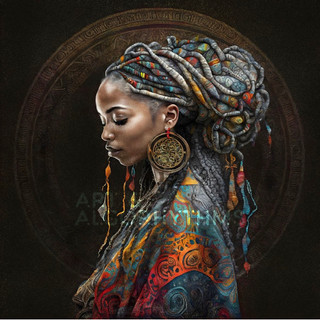
I grew up not knowing who I was. In late adolescence, as I approached adulthood, my rebellious spirit led me to find ways to burst bubbles and break down walls. I found myself. I saw myself as a Black woman for the first time when I braided my hair.
For a long time I was coerced into following standards set by a hypocritical and cruel society that wounded me, excluded me, and destroyed my self-esteem daily. This society was not only patriarchal but also racist. The struggle for Black women has always been two-fold. Before a Black person can be seen as a woman, she must first be seen as a human being. Racism dehumanizes us, silences us, and makes us invisible. When we are seen, we are objectified and hypersexualized.
Next come the racist-sexist stigmas and stereotypes. I occupied many spaces where I felt out of place because my peers never went there. I always questioned this fact, yet someone would inevitably question why I was in those places. Again, attempts to freeze me in place. These were the walls of social apartheid. Anyone without the “ticket” to enter—my Black brothers and sisters—was excluded. This false racial democracy still affects Brazilian society.
Some still talk about reverse racism. Black people do not hold the institutional power to commit reverse racism. Reverse racism might exist if, for 500 years, Black people had enslaved white people. Nevertheless, I continue to burst bubbles, and no one has the right to stop me. Besides legs, I have wings and I can fly.
By Alessandra Martins


Comments